Voting in the City of Nanaimo? Click here to use our Know Your Vote tool for a custom ranking of Mayor and Council candidates based on how much you agree, or disagree, with them on key issues.
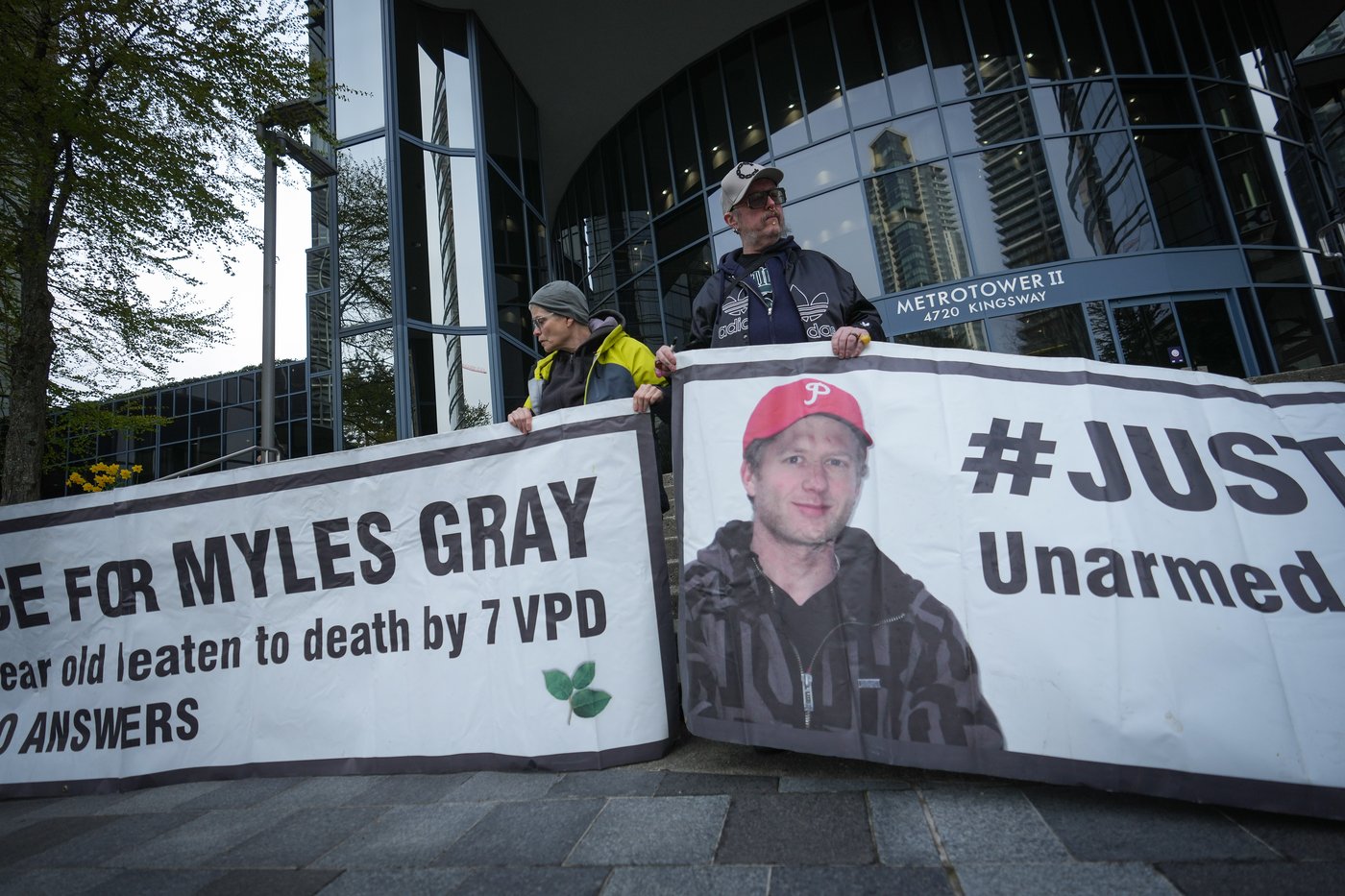
Protesters hold banners with a photograph of Myles Gray, who died following a confrontation with several police officers in 2015, before the start of a coroner's inquest into his death, in Burnaby, B.C., on Monday, April 17, 2023. THE CANADIAN PRESS/Darryl Dyck

Vancouver officer says colleague smart to shelter from Myles Gray before fatal arrest

Oct 13, 2026 | 10:35 AM

VANCOUVER — A Vancouver police officer involved in the violent 2015 arrest in which Myles Gray died says he had a duty to the public to get eyes on Gray after the man tried to rip open the door of a vehicle where another officer had taken shelter.

Const. Eric Birzneck says it was a “smart move” by Const. Hardeep Sahota to shelter in the vehicle since the officer was alone and faced with a suspect she described as “jacked.”

But Birzneck also says it was a “bizarre” situation and he had never before heard of an officer retreating to their vehicle in such a way.

Birzneck is testifying at a hearing by the Office of the Police Complaint Commissioner in Vancouver to determine if he or six other officers intentionally or recklessly used unnecessary force in the altercation.

A police disciplinary process previously determined none of the officers committed misconduct, and no charges have been laid over Gray’s death, which a 2023 coroner’s inquest ruled was a homicide, a term that does not assign legal blame.

The inquest heard that Gray was left with injuries that included a fractured eye socket, a crushed voice box and ruptured testicles, while a paramedic told the inquest that Gray’s bruising was so severe, he initially thought he was not a white man.

Recordings of police radio traffic in the lead-up to Gray’s death were played at Tuesday’s hearing, which is hearing from some of the officers under investigation for the first time.

The audio includes officers being initially told that someone had complained about a person spraying their mother with water and an officer later reporting that the person was “acting a little aggressive,” and asking for “hurry-up cover” meaning other officers should arrive quickly.

Birzneck is the first of the respondent officers to testify at the hearing, which opened in January but has been the subject of a series of delays.

At least three of the other officers involved in Gray’s deadly arrest are scheduled to testify: constables Beau Spencer, Nick Thompson and Josh Wong.

Birzneck spent much of his early testimony on Tuesday discussing his use-of force training and experience.

He said he had never used his baton or pepper spray on another person before the altercation with Gray on Aug. 13, 2015.

Birzneck said he received training in the use of a baton, the use of the spray, and “vascular neck restraint” and he had previously been a use-of-force instructor when employed by the Canada Border Services Agency.

He had also taken a crisis negotiation course.

He said vascular neck restraint, done with an arm around someone’s neck, is not meant to cut off oxygen but that putting pressure on both sides of the neck will cut off blood flow to temporarily cause a level of unconsciousness.

He said trained officers know how to do the restraint with proper alignment and can tell if the restraint is cutting off oxygen if the person is coughing.

Birzneck said that in August 2015 he believed he could safely apply the restraint if required.

The hearing is taking place in a classroom in a UBC building in downtown Vancouver,

More than a dozen people, including lawyers and others involved in the hearing, sat at six long tables watching the testimony that is also being audio streamed online.

Birzneck’s lawyer Greg Cavouras started the day by telling adjudicator Elizabeth Arnold-Bailey that the hearing would learn that Birzneck was quickly “met with aggression” by Gray and that his client used force only when he believed an assault was imminent.

Cavouras said it was Gray who drove the outcome of the altercation and that his client tried to defuse a dangerous situation and only used force he reasonably thought necessary.

He said Gray’s “cardiac event” occurred approximately 15 minutes after Birzneck’s last contact with him.

This report by The Canadian Press was first published Oct. 13, 2026.

Ashley Joannou, The Canadian Press