LOCAL NEWS, DELIVERED DAILY. Subscribe to our daily news wrap and get the top stories sent straight to your inbox every evening.
While multiple daily high-temperature records were broken last month, Nanaimo saw an average amount of heat and rain for July, while being spared the worst of wildfires and drought-like conditions plaguing much of the B.C. mainland. (Image Credit: Jordan Davidson/NanaimoNewsNOW)
summer season

Drought concerns easing due to lopsided Vancouver Island rainfall

Aug 8, 2026 | 6:08 AM

NANAIMO — With concerns surrounding drought and wildfires top of mind for many British Columbians right now, Vancouver Island has so far been mostly spared this year, but summer isn’t over yet.

As of July 7, the B.C. drought portal had eastern Vancouver Island, encompassing areas north of Campbell River down to Sooke, at a drought level two out of five, down from levels of four and five at the start of June.

Meteorologist with Environment Canada Brian Proctor said other parts of the island saw a very different story last month.

“If we start off down in Victoria, it was drier than normal, and then as we start getting up into Nanaimo, normal again, and then got to Comox/Campbell River, it was wetter than normal, so really an interesting month.”
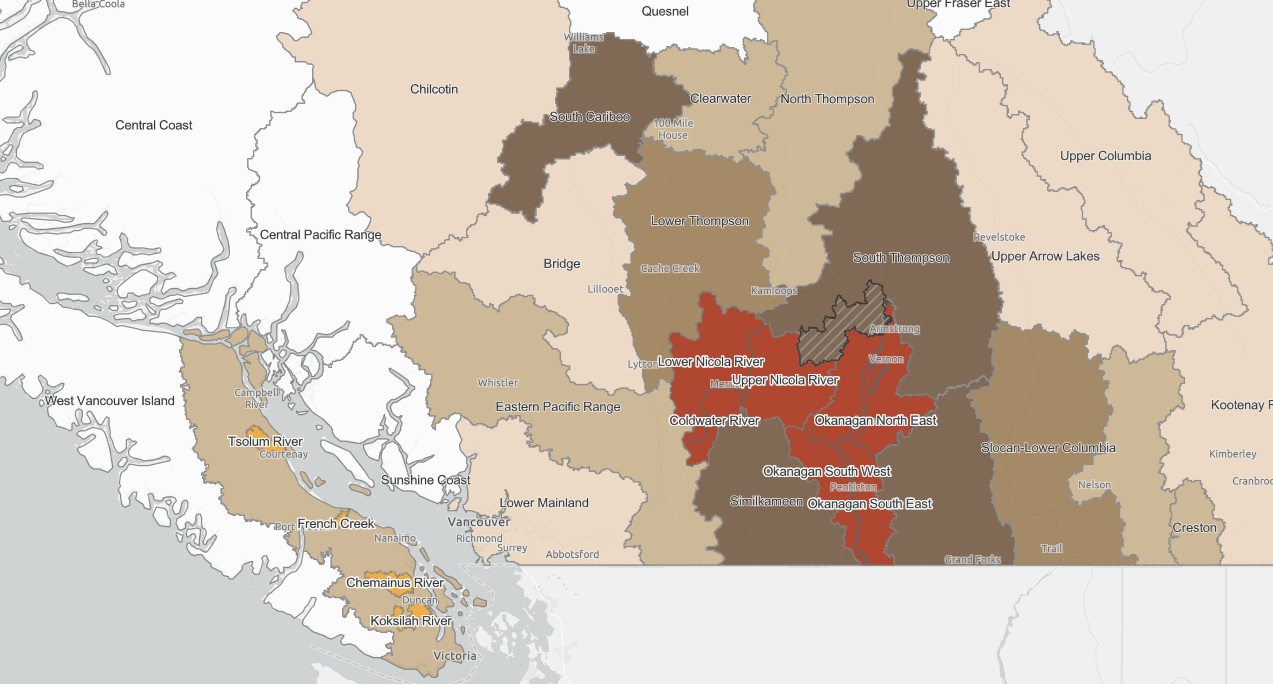
Drought conditions in the central and southern interior remain around levels three or four with high water scarcity levels as wildfires continue to burn out of control in the Thompson-Nicola Regional District and surrounding area.
Drought conditions in the central and southern interior remain around levels three or four with high water scarcity levels as wildfires continue to burn out of control in the Thompson-Nicola Regional District and surrounding area. (Image Credit: B.C. Drought Portal)

With a mean temperature of 18.7 degrees Celsius and 107 per cent of our usual precipitation, July 2026 was on par for an average month of Nanaimo weather, despite a few days of record-breaking high temperatures.

Compared to Comox and Campbell River, where each community received 183 per cent of their regular rainfall last month, 43.6 and 60.6 millimetres respectively, with the mean temperature right around average for both communities.

Western Vancouver Island is currently at drought level zero, down from level two in June, with most areas of northern B.C. reporting similar conditions.

Proctor said there are a few reasons for the discrepancy in weather conditions from one side of the island to the other, with geography and the time of year playing a big part.

“The mountains on the island help to give us a bit of a rain shadow on the east side, and the precip wasn’t as substantial as it would be if it was a November or December kind of storm when that moisture would have been able to surface on the east side of the island. It was the outer coast of the west side of the island, and the northern tip of the island that took the brunt of all that precipitation.”

Looking ahead for the rest of the summer, Proctor said their weather patterns are predicting less rain and slightly above-normal temperatures into the fall for much of eastern Vancouver Island, from Nanaimo up to Campbell River.

“Which means the forest fire hazard out there that we’re seeing is not going to. It’s probably going to worsen a little bit as we move through August before we get into September.”

Follow us on Facebook. Join Everything Nanaimo on Facebook and stay connected with everything happening on central Vancouver Island.

info@nanaimonewsnow.com

Follow us on: Twitter (X) | Bluesky | Facebook