LOCAL NEWS, DELIVERED DAILY. Subscribe to our daily news wrap and get the top stories sent straight to your inbox every evening.
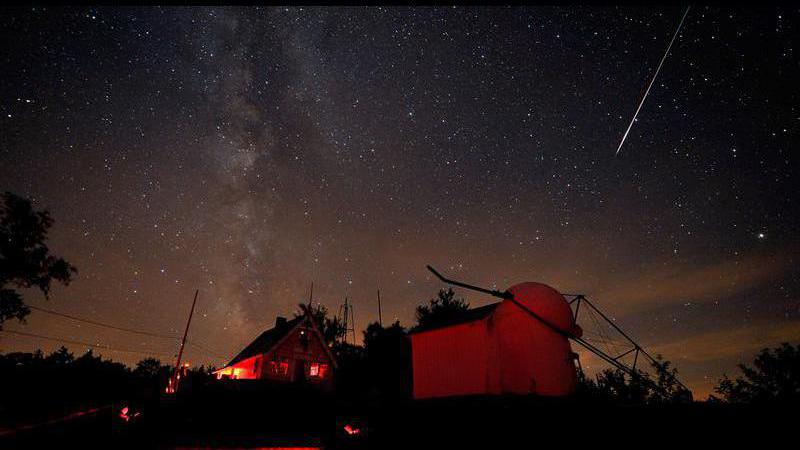
While the peak of the Persieds meteor shower has arrived, a bright moon is significantly diminishing the dazzling display, according to VIU astronomy professor Dr. Gregory Arkos (Dennis Di Cocco/Sky & Telescope)
meteor season

Near full moon dampening annual meteor shower

Aug 12, 2025 | 5:27 AM

NANAIMO — Nearly unobstructed summer skies typically provide the perfect canvas to enjoy a reliably productive meteor display, however the moon has other ideas.

A nearly full moon means the Persieds meteor showers peaking overnight on Tuesday, Aug. 12 and Wednesday, Aug 13 won’t be nearly as spectacular, according to a Vancouver Island university astronomy professor.

Dr. Gregory Arkos said the bright moon is clashing with the dazzling show.

“It’s so bright that it just washes out all of those fainter meteors, which are the ones that make up most of the 100 per hour that people tend to see.”


As a potential mitigating strategy, Arkos suggests viewing the night sky in the 10 p.m. to midnight range when the moon is lower in the sky.

The presence of a prominent moon means around a dozen viewable meteors an hour is a reasonable assumption, Arkos said.

“I think people have to kind of temper their expectations.”

For those committed star-gazers, Arkos said early night viewings could reveal the odd bright-streaking fireball, representing chunks of ice and debris heating up upon entering earth’s atmosphere.

Perhaps viewings will be more noticeable in a week or so when the moon isn’t as much as a factor, However, Arkos said the meteor shower’s peak will begin to fade as the moon isn’t as bright.

He suggests using the naked eye and seeking out as dark as location as possible, away from light pollution, as well as an area where as much of the night sky as possible can be viewed.

“They kind of zip all over the whole sky, they’ll be radiating outward from that point,” Arkos said. “There’s no one better location, it’s really just kind of taking in as much of the sky as you can with your eyes.”

In addition to paying attention to meteors, Dr. Arkos said an intriguing planetary alignment has formed, with several planets visible in the pre-dawn sky.

Jupiter and Venus in the low northeast near the horizon are particularly prominent, Arkos said.

“They are crazy bright, you don’t need anything to see them other than your eyes; they’re very bright and very close together.”

A bit higher to the south Saturn is visible, while Arkos noted Uranus and Neptune are also among the planetary formation, but said those planets are too dim for the naked eye to pick up.

In a week to two weeks, Mercury joins Venus and Jupiter near the horizon, although Arkos said the planet closest to the sun won’t be easy to see.

“If you happen to be up early, or you are up late watching those Persieds, it might be something to go and look for,” Arkos concluded.

Local news. Delivered. Free. Subscribe to our daily news wrap and get our top local stories delivered to your email inbox every evening.

info@nanaimonewsnow.com

Follow us on: Twitter (X) | Bluesky | Facebook