Local news. Delivered. Free. Click here and subscribe to our daily news wrap and get our top local stories delivered to your email inbox every evening.
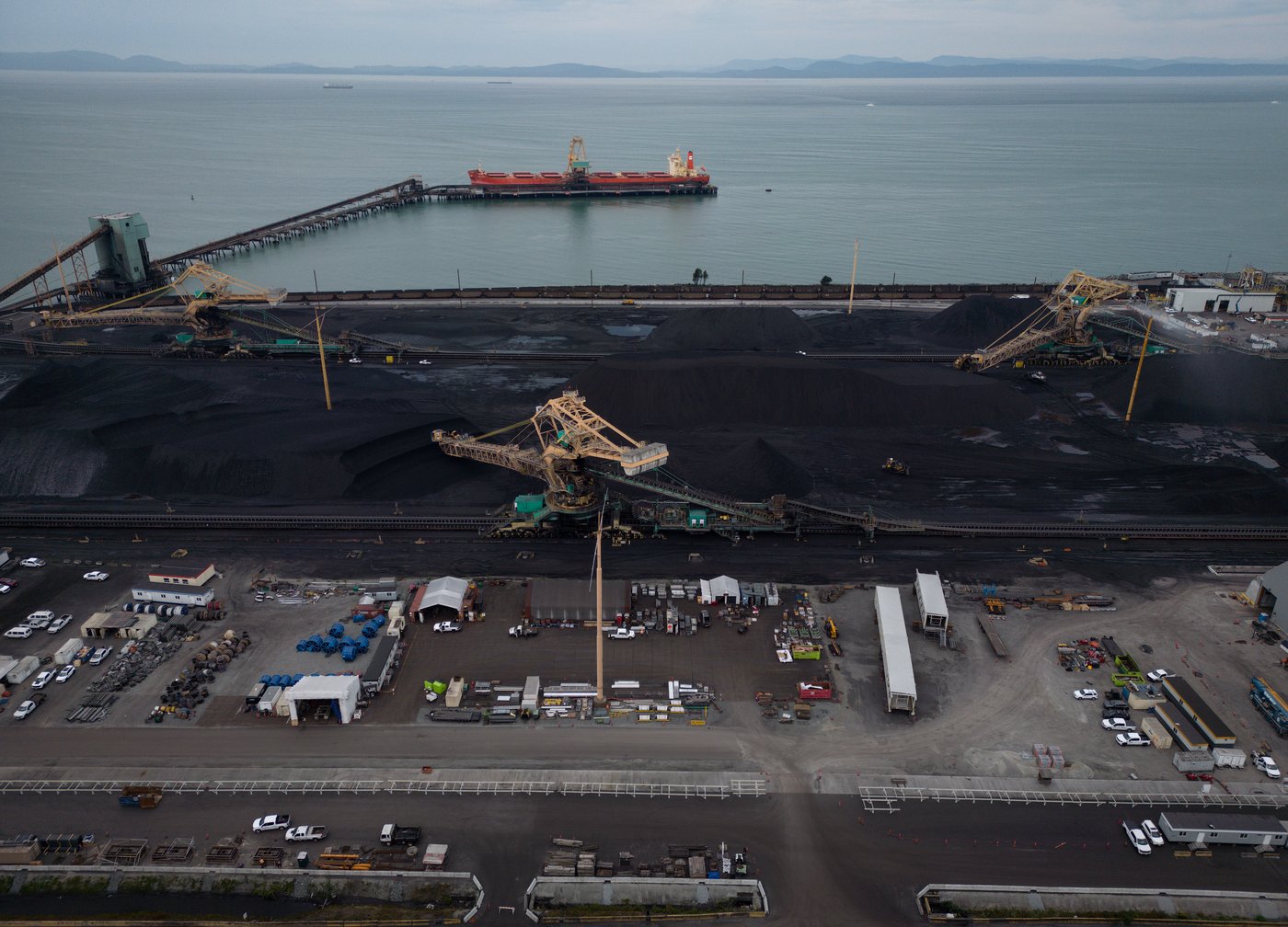
Westshore Terminals' coal export terminal is seen in an aerial view at Roberts Bank in Delta, B.C., on Thursday, July 16, 2026. THE CANADIAN PRESS/Darryl Dyck

Ottawa quietly abandoned promise to end thermal coal exports, audit says

Oct 29, 2026 | 9:41 AM

OTTAWA — Environment and Climate Change Canada abandoned its work to end thermal coal exports, without any record of being directed to do so — something Canada’s auditor general said she’s never seen before in 20 years of auditing the federal government.

Karen Hogan tabled her office’s latest audit on Thursday. It also found Environment Canada stopped its work on phasing out thermal coal exports without ever notifying the public or other federal departments working on the file.

The report — which was issued by Canada’s environment commissioner — criticized the move and pointed out that Canada is co-chair of an international alliance meant to help countries transition away from coal, which it helped to launch in 2017.

Burning coal is one of the most polluting forms of electricity generation. Between 2011 and 2023, Canada saw a 68 per cent drop in the amount of coal it burned to power its grid.


In 2021, Canada committed to banning thermal coal exports by 2030.

Environment Minister Julie Dabrusin — who was in Montreal Thursday for the Canada-EU summit and was not made available for questions on the audit — said in a media statement Canada was “pausing” its work.

Liberal MP Wade Grant, Dabrusin’s parliamentary secretary, was put forward to respond to journalists’ questions on the report, along with five other ministers who couldn’t or wouldn’t speak to the decision to stop the work.

Pressed on whether Canada is still committed to phasing out thermal coal exports by 2030, Grant said it’s “something (the government) will look at.”

Thursday’s audit found that while Environment Canada worked for three years to find a way to enforce the ban, that work stopped altogether in November 2024 after lobbying from the coal industry.

“The department did not produce evidence of an official direction to discontinue work on the ban in 2024,” the audit said.

Taking questions from reporters Thursday, both Hogan and Deputy Auditor General Andrew Hayes said that they’d never seen any department do anything similar in their years at the Office of the Auditor General.

“Indeed, what we would have expected to see is that the department had documented its analysis that it would have provided to decision-makers, and that there would have been a paper trail back from decision-makers to confirm that work should stop,” Hayes said.

“I don’t remember a time in the last 20 years where I’ve seen work stop like that.”

Even the work to enforce the ban was scaled down before Ottawa ultimately gave up on it.

The audit found that between October 2021 and February 2024, Environment Canada officials were trying to use existing laws to enforce the export ban — including by regulating it as a toxic substance, similarly to what Ottawa is doing now with single-use plastics.

The audit said that by February 2024, those efforts shifted to non-regulatory approaches, including “voluntary measures,” though it doesn’t say exactly what those measures were.

The decision to stop the work wasn’t formalized until August 2025, when the federal government was looking for cost-saving measures, said the audit. Still, Ottawa didn’t tell the public.

“However, we also found no clear records to show that the department had provided the minister with an assessment of the implications of stopping all work on the export ban,” the audit report said.

“While the commitment had been announced internationally and noted in multiple federal strategies, the work on the ban was stopped with no public announcement.”

Thermal coal exports were higher in 2025 than they were in 2021, the audit report says.

The report criticized the government’s secrecy on the file.

“The lack of public information and updates on the government’s current approach is concerning,” it said.

“Transparency in decision making provides certainty and enables interested parties, such as provincial and territorial governments, coal mining companies, transportation authorities, shipping terminals, and the labour force to contribute to a just transition.”

The report said 61 per cent of thermal coal shipped from Canadian ports in 2025 came up from the United States, largely from Washington, Oregon and California.

The American mines send it by train north to shipping terminals in British Columbia, mainly because regulations in the U.S. make it challenging to build export infrastructure along the Pacific coast to ship to Asian markets.

Former B.C. premier David Eby suggested Ottawa could use Canada’s role in facilitating exports of U.S. thermal coal as leverage in trade negotiations.

In August, Eby — apparently unaware Ottawa already had abandoned the work — told reporters the federal government should move faster to phase out exports of thermal coal.

Efforts to reach Eby, who was defeated recently in a snap election he called, were unsuccessful on Thursday.

The reports from the auditor general’s office also looked into Global Affairs Canada’s role in overseeing $16 billion in commitments to international coal transition programs.

Canada committed $15 billion to the Women-Led Coal Transition Mechanism, and another $1 billion in low-interest loans to the Climate Investment Funds’ Accelerating Coal Transition investment program, which is jointly funded by Canada, the United Kingdom, Germany and Denmark. That $1-billion investment made up 42 per cent of the program’s funding, the audit found.

“For Global Affairs Canada, this contribution was also one of the department’s single largest project investments ever made,” the report said.

“The program finances country-led investment plans with projects designed to accelerate coal retirement, scale up clean energy alternatives, and mitigate socio‑economic impacts on affected workers and communities. Projects are expected to continue up to 2047.”

The audit reported Environment Canada never informed Global Affairs Canada of the decision to stop work in November 2024.

“We found that Global Affairs Canada was involved in the work on the thermal coal export ban only at the request of Environment and Climate Change Canada,” the report said.

“In accordance with its responsibilities for foreign affairs and trade policy, Global Affairs Canada provided information on the trade risks associated with potential implementation options for a thermal coal export ban.”

This report by The Canadian Press was first published Oct. 29, 2026.

Nick Murray, The Canadian Press